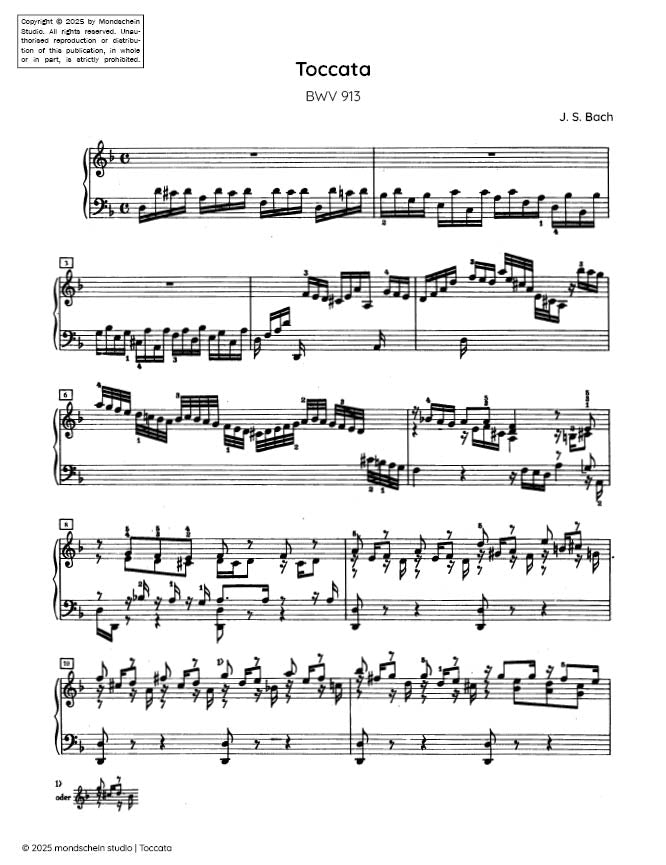
Johann Sebastian Bach's Toccata in D minor, BWV 913, is a sprawling, multi-sectional masterpiece that showcases the composer's youthful mastery of the "stylus phantasticus" - a free, improvisational style characteristic of the North German organ school. Likely composed during his tenure at Weimar (c. 1708 - 1717), the work is far more structured and contemplative than its famous organ cousin (the BWV 565). It opens with a brilliant, virtuosic flourish of scales and arpeggios that quickly gives way to a series of strictly constructed sections, including two distinct fugues. The first fugue is characterized by its steady, rhythmic drive, while the second acts as a grand, double-fugal finale that builds to a climax of intellectual and technical rigor. Throughout the piece, Bach balances raw emotional expression with a sophisticated understanding of counterpoint, making BWV 913 a quintessential bridge between his early experimental phase and his later, more refined keyboard works.
This edition is a reissue of music originally published by Edition Peters.